Saturday, December 03, 2005

the relevance of ARCHITECTURE WEEK

How can architects help prospective homeowners?

I am referring to prospective homeowner like Cecilio E. Rahon, Jr. an OFW who wrote me while he was onboard M/V Georgios S of Bright Maritime Corporation asking for assistance. Quoting in part his e-mail ," Your position as dean of the college of architecture is quite formidable parang nakakahiya yatang magtanong but you sound very friendly on the radio".

Let me explain this. Second MateCecilio Rahon is a listener to KAYAMOBATO-ONLINE, a weekly 30 minute radio program simulcast over three Voice of America (VOA) shortwave bands: 11.730 mhz/11.890 mhz/15.190mhz using the facilities of Radio Pilipinas OFW station and heard every Saturday morning by our kabayan dollar earners in the Middle East, some parts of India and South East Asia, some parts of Europe and United States.

Cecilio was onboard their ship docked at Johor Port,Malaysia leaving for Amsterdam when he sent his e-mail to my address, rlpunzalan@yahoo.com.

The letter continues," Do you know any website or person that I can ask regarding building an energy efficient house? What are the things to consider? I am totally clueless and I need information. I bought a lot in Laoag City and there is where I plan to build it." The letter ended explaining that he will still be onboard for a month and that he will send me an e-mail for more information about his request for assistance as soon as he gets to an internet shop at his port of destination.

A status report on the request of Cecilio Rahon:

1. This blogger and KAYAMOBATO-ONLINE program host has aired over the radio program, both on the OFW program and a local program ( a 1- hour Kaya Mo Ba To? radio broadcast over DZRM AM 1278 khz, 2-3 pm every Sunday also produced and hosted by me) that I have a good news for our kabayan Cecilio.

I announced several times that, "considering your very good intentions of building an energy efficient house to be typical need and of far-reaching significance to all homeowners in the country, the United Architects of the Philippines, through its Green Architecture Movement has accepted the challenge to provide assistance to Cecilio in designing your house according to your wish of having it energy-efficient. This blog spot and the radio program will run a series of informative segment, among other regular segments , featuring the progress of actions being undertaken in response to Cecilio's request and to deal with it as a work-in -progress. Cecilio by now must have started monitoring the progress.

2. Cecilio, I want you to understand that there are several ways of materialising your concept of an energy-efficient house. A basic design approach in constructing an energy- efficient house is described as follows:

BUILDING ENVELOPE ( Kabalutan ng Bahay o Gusali)

Ang init ng araw ay pumapasok at lumilisan sa kabahayan sa pamamagitan ng bubong, pader, mga bintana, at sahig o kasahigan. Ang lahat na naturang elemento ay tinatawag na building envelope. Ang Envelope Design o Disenyo ng Kabalutan ng bahay o gusali ay ang kabuuan ng hugis ng bahay at sangkap na materiales ay ang kabuuang sistema upang magdulot ng maginhawang pakiramdam sa mga naninirahan at makatipid sa enerhiya.


GENERAL BUILDING PRINCIPLES ( Mga Panuntunan sa Desenyo ng Bahay )

Ibaba ang init sa loob ng bahay sa araw(daytime) sa pamamagitan ng wastong envelope design.

Ang kabuuang desenyo ay dapat makapag-palamig sa temperatura sa loob ng bahay sa pamamagitan ng maaliwalas na daloy ng malamig na hangin na buhat sa labas .

Ang mga elemento ng passive cooling (Fig.A and Fig.B) ay ang sumusunod:

- Ang natural na bentilasion ay mangyayari kung maiiwasan ang mga sagabal sa pagpasok ng
sariwang hangin galing sa labas.

- Wastong dami at sukat ng bintana

- Wastong uri ng bubungan

- Wastong gamit ng insulasyon sa bubong at dingding at pader ng bahay

- Wastong pag-plano ng lugar para sa pang-araw na gawain at pang-gabing mahimbing na pag- tulog

- Pag-gamit ng wastong kulay para sa bubong. (Light colors are recommended for roof and
walls to reflect more solar radiation and reduce heat gain.)

- Pag-gamit ng bentilador ( electric fan o ceiling fan) sa panahon na walang natural na daloy ng
hangin o breeze.
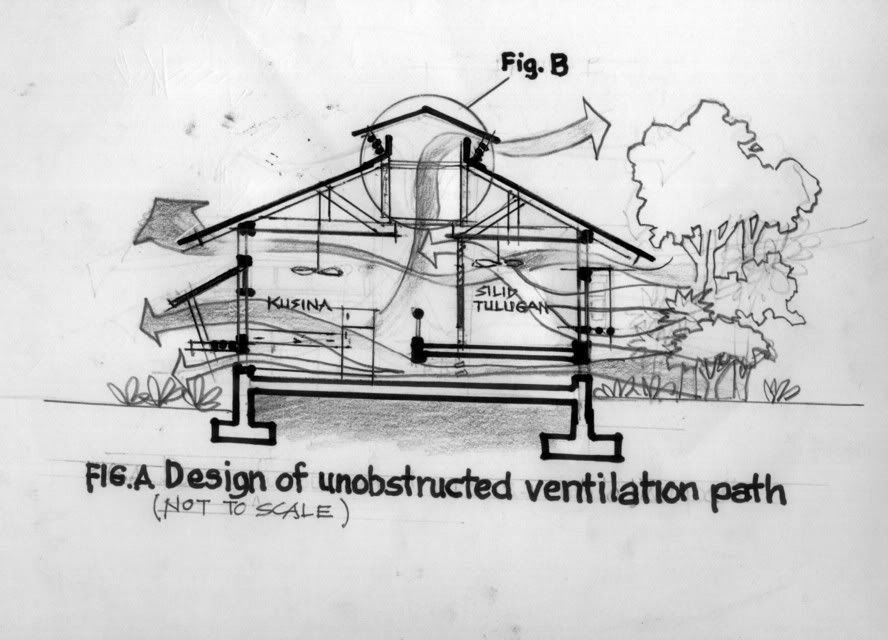

Fig.A Design of unobstructed ventilation path
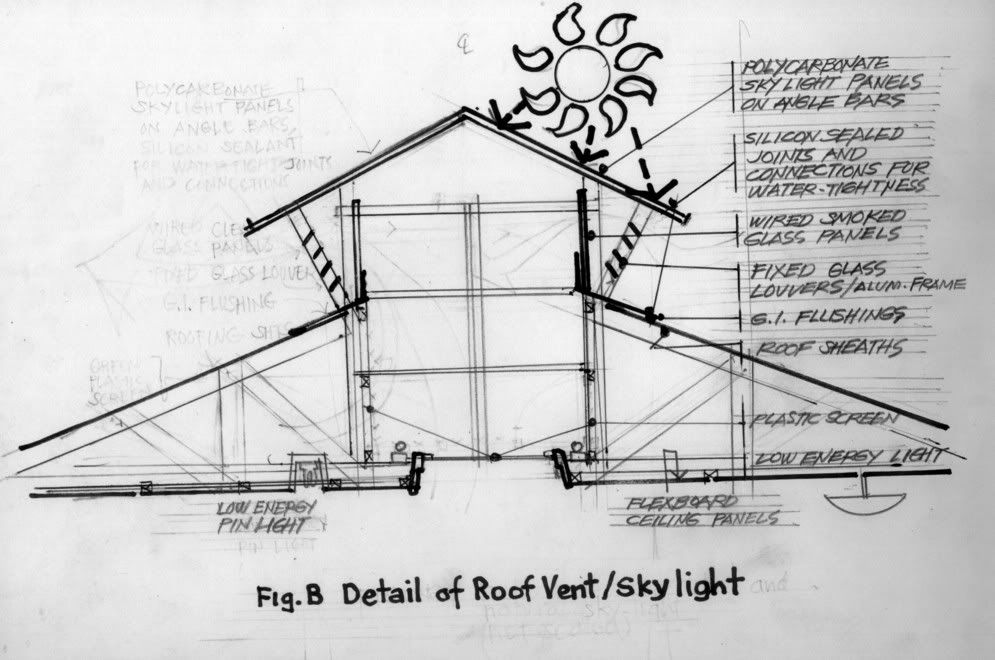

Fig.B Detail of Roof Vent/Skylight

We shall print in the next blogspots the progress of Cecilio Rahon's energy-efficient house as I receive the design output from the UAP Green Architecture Movement. You know Cecilio I have even challenged our senior architecture students in the College of Architecture of the University of Pangasinan to conduct research work on the subject design problem.

This year, Architecture Week is celebrated on December 3 to 10. I would like to think that by our action ( I refer to all Pilipino architects ) of reaching out to other kababayan homeowners and even in partial compliance to render professional service without expecting renumeration from a prospective kabayan homeowner like Cecilio Rahon, Jr. who was very honest in asking assistance (he admitted he was clueless) for the design of his energy efficient house, all Pinoy architects will look at every week of the year as an opportunity to celebrate the significance of Architecture Week.

Friday, November 11, 2005

Microvitum

Are there entities smaller than atoms or electrons or protons? Are there objects subtler than ectoplasm?

Answers to these questions articulated by P.R. Sarkar, the Renaissance Man profounder and spiritual master of Ananda Marga open new insights and offer penetrating "kaya mo ba ito?" challenge for further research work to present day scientists and scholars.

In a book published by Ananda Marga Publications, P.R.Sarkar ( also known as Shrii Shrii Anandamurti) gave a discourse on MICROVITUM- THE MYSTERIOUS EMANATION OF COSMIC FACTOR.

The discourse on MICROVITUM explains that there are entities which comes in the realm of both physicality and psychic expressions which are smaller or subtler than atoms or electrons or protons, and in the psychic realm they may be subtler than ectoplasm. For such objects or for such entities P.R. Sarkar use the term microvitum.

This microvita are not of protoplasmic order and as such they have got little to do with with carbon-molecules or carbon atoms, which are treated as the initial points or initial stage of life in this universe.

So far as the physicality is concerned, the position of these microvita is just between ectoplasm and electron. But they are neither ectoplasm nor electron. According to P.R. Sarkar, it is a human wont that whatever we know regaradding any subject or any object, when we know that it exists but its characteristics or other particulars are not known to us, we say it is "mysterious". So regarding this microvita, we may say they are mysterious.

That is why I used the term "Microvitum, the mysterious emanation of Cosmic Factor." They are not of protoplasmic order and hence the question of their protozoic structure or metazoic structure does not arise. They are something mysterious.

Microvita classified - P.R. Sarkar explains the three categories of microvita which are :

A) Those coming within the scope of microscope.

B) Those not coming within the scope of perception but coming within the scope of perception as a result of their actional vibrations.

C) Those not coming within the scope of common perception but coming within the scope of a special type of perception which is actually the reflection of conception within the periphery of perception. And such perception , that special type of perception, may be felt or realized by persons having highly developed minds, having spiritually oriented minds.

Regarding these microvita of cruder order which may come within the scope of microscope, people give them the name 'virus'. They say ,"This disease is of virus origin." But virus is a vague term. The better term will be mcrovitum, and not virus.

Mobility of Microvita- According to P.R. Sarkar, microvita move througout the entire universe, from one celestial body to another. They move everywhere crossing the boundaries of nebulae, piercing through milkyways, galaxies, stars, satelites, planets and meteors. Like other psychic and psycho-phyusical beings, they have also got basic characteristics- such as existing , dying and multiplying. They move unbarred, without caring for the atmospheric condition or barometric reading.

How do they move?
( to be continued )

Sunday, November 06, 2005

TANTRIC MEDITATION AND VEGETARIANISM

In the discussion on meditation, a healthy body is a must.

To keep a healthy body proper food and asanas are obviously twin subjects that cannot be ignored. Practitioners of tantra yoga adheres to vegetarianism as a key ingredient in maintaining a healthy lifestyle. Below are some of many arguments to support vegetarianism :

1) Is it natural for humans to eat meat?

Human beings are natural non-carnivores. His or her digestive system evolving for over a million years living on fruits, nuts, grains and vegetables manifest a slow digestion of vegetables and fruits shown by having bowels 12 times the length of the human body.

Human digestive system, the structures of jaw and tooth and bodily function are distinct from that of carnivorous animals.

The bowels of carnivores is shorter, only 3 times the length of the body, for faster expulsion of putrerfactive bacteria from decomposing flesh; stomachs with ten times as much hydrochloric acid as non -carnivorous animals, to digest fibrous tissues and bones.

2) What are the dangers in eating meat?

Before and during the agony of being slaughtered the biochemistry of the terrified animal undergoes changes as it struggles and hang on fighting for dear life.

Toxic by-products and large quantities of adrenalin are forced throughout the body, thus poisoning the entire carcass, leaving toxic wastes in the blood and tissues.

The fats of animal flesh such as cholesterol line the walls of blood vessels of the non-vegetarian, and as the meat-eater gets older, the openings of his vessels get smaller and smaller.

Pressure on the heart increases often resulting to heart failure, high blood pressure and stroke.

It is interesting to note that these diseases are not prevalent in countries where meat consumption is low. Among the most notorious wastes that meat-eaters store in the body are urea and uric acid. Beefsteak contains 14 grams of uric acid per pound.

An American doctor analyzed the urine of meat-eaters and vegetarians and found that the kidneys of meat-eaters have to do three times the amount of work to eliminate poisonous nitrogen compounds in meat than do the kidneys of vegetarians. When people are young, they are usually able to bear this extra burden so that no evidence of injury or disease appears; but as the kidneys age and become worn out prematurely, they become less efficient resulting to kidney disease.

When kidneys can no longer handle the excessively heavy load of a meat-eating diet, the unexcreted uric acid is deposited throughout the body. There it is abssorbed by the muscles like a sponge soaking up water and later it can harden and form crystals.

When this happens in the joints, the painful condition of gout, arthritis, rheumatism result; when the uric acid collects in the nerves, neurithis and sciatica occur. Many doctors are advising patients suffering from these diseases to stop eating meat completely or reduce intake drastically.

3) Is it right to kill animals?

P.R. Sarkar, the Renaissance Man and a profounder of vegetarianism, teaches:

"As far as possible articles of food are to be selected from amongst the sets of items where the development of consciousness is comparatively littlle, i.e. if vegetables are available, animals should not be slaughtered. Secondly, under any circumstances before killing any animals having developed or undeveloped consciousness, it is to be considered whether it is possible to live in a healthy body without taking such lives."

4) The politics of hunger.

Meat is the most uneconomical and inefficient food we can eat.

In order to produce meat vast track of land is used to grow cattle feed. The cattle consumes about ten times more protein and calories than they return in form of their meat. In other words, 90% "goes down the drain."

Adding the expenses of cattle feed to the other costs of cattle raising, the cost of meat protein comes to about twenty times the cost of plant protein.

Instead of wasting land for meat production these land could be used far more productively if utilized to plant grains, beans and legumes for direct human consumption. The following data taken from "What's Wrong with Eating Meat, " an Ananda Marga Publication, lists more economic reasons why vegetarianism is gaining ground as an alternative lifestyle :

- If we conserve our grain supply and gave it to the poor and malnourished, instead of to the cattle, we could easily feed all of the chronically underfed people of the world.

- If we ate half as much meat, we could relese enough food to feed the entire " developing world."

- Recent studies by nutritionists have shown that reducing meat production by just 10 % would relese enough grain to feed 60 million people.

- The shocking and tragic truth is that 80-90% of all grain grown in America is used to feed meat animals.

- Twenty years ago, the average American ate 50 pounds of meat annually. Because of America's "fixation on meat" , most eat twice the daily recommended protein allowance. Learning the real facts behind the "food shortage" is fundamental to an understanding of how we can properly utilize the world's resources.

Clearly the decision whether to eat meat or not is a personal one but based on the arguments against it; it is rather difficult to find a case in favor of meat-eating. (Unless of course, where it is absolutely necessary for physical reasons.)

Saturday, October 08, 2005

tantric meditation, continued

ASANAS: RESTORING NORMAL FUNCTIONING OF GLANDS

The human mind carries with it the seed of desire, a momentum which it must express. To express this momentum it adopts vrttis or ways of expression of mind or expression of sentiments.

The brain cannot work directly to perform its function of creating messages through the nerves without passing through sub-stations called glands. The glands secrete various hormonal substances which in turn affect the complex operation of the organs of the body.

Thus the seed of the vrtti is in the brain, but its first expression is in the glands.

There is mental restlessness because of the distracting effects of the vrttis which seeks expression through the organs of hearing, touch, sight, taste and smell. Since the vrttis are created by the glands, one can regulate the expression of the vrttis and therefore balance the mind by regulating the glandular secretion.

The yogic postures or asanas is the yogic system that makes the glands function efficiently. These bodily postures, held motionless for a prescribed period of time, puts pressure on selected glands thus balancing their secretion.

Asanas also prevents diseases and keep the youthful flexibility of the human body. As prescribed posture dispose one troublesome vrtti after another as the glandular dysfunctions are cured, the mind gradually becomes peaceful and focused.

In Ananda Marga, personal sets of asanas are prescribed by competent acharyas (teachers). Readers should not to take the risk of practicing asanas unless guided by Ananda Marga teachers.

For inquiries call telephone number 436-2946. Text your questions to 0919-734-9704. Ananda Marga acharyas will always be ready to help without any renumeration.

There are a few simple asanas that are good to start with. Three postures are described as follows:

1. Snake Posture: Lie down on your chest. Supporting the weight on the palms, raise the chest, directing your head backward, Look at the ceiling. Breathe in while rising, and after having risen, hold your breath for eight seconds. Come down to original position while breathing out. Practice eight times.

2. Half-Tortoise or Long Bowing Posture : Kneel down and holding the palms together, extend the arms upward keeping them close to the ears. then bend forward in a posture of bowing down, touching the floor with the tip of the nose and the forehead. the buttocks must continue to touch the heels. While bending down breathe out and stay in a state of complete exhalation for eight seconds then rise up, beathing in. Practice eight times.

3. Yogamudra Posture: Sit in crossed legged position. Pass both hands backward and grip the left wrist with the right hand. Then bring the forehead and the nose into contact with the floor, breathing out during the process. Maintain this position for eight seconds and rise up, breathing in. Practice eight times.

Asanas, like other disciplines require the observance of certain basic guidelines as follows:

1. Before practicing asanas it is best to take a bath which is ended cool, or if in shortage of time, cool down the heated areas of the body i.e. feet, knees, elbows hands, face neck, top of head with cool water. A special procedure has been designed for this , known as "half bath," which can easily be demonstrated.

2. Asanas should not be practiced in the open air because it may result in sudden exposure leading to a cold. While practicing asanas indoors one should be sure, though to have fresh air, preferably with open windows. No smoke should be allowed to enter the room.

3. One should wear tight fitting underwear to protect the organs during asanas. For male a special underwear called "lungota" is recommended.

4. Practice asanas on a blanket or a mat. Do not do asanas on bare ground, because you may catch a cold, and some secretions which come from the body while practicing asanas may be destroyed.

5. Breathing should flow freely through the left or both nostrils. (Left and right nostrils alternate their dominance in regular intervals and correspond with respectively subtler and cruder energy flows. Asanas should be done when subtler energies are flowing.) One may open the left nostril by lying on the right side with the head cushioned on arm and elbow, and breathing regularly for a few minutes.

6. Take sentient food . Follow a vegetarian diet.

7. Asanas should not be done on a full stomach and only after a minimum of 2 1/2 to 3 hours after a full meal.

8. After completing the asanas, massage of the entire body should be done.

9. After massage, remain in "corpse posture" for at least 2 minutes: Lie back on the floor and to prevent chill, cover the body up to the neck with a blanket. Relax completely keeping the arm spread away from the chest and legs comfortably apart. Imagine that your body has become totally inert, like a corpse. Remain for a few minutes.

10. After corpse pose, do not come in contact with water for at least ten minutes, and do not take food until after 30 minutes.

11. If it is necessary to go outdoors after practicing asanas and body temperature has not come down to a normal level, or if there is any difference between the room temperature and the outdoor temperature, you must cover your body when going out. If possible inhale a deep breath inside the room and exhale it after coming outside. In that way there will be no chance of catching cold.

12. One should not practice any free-hand exercise, running or sports after asanas.

13. There are no restrictions of nostril or diet for the following asanas: Lotus posture, siddha posture, half siddha posture, crossed leg sitting posture, brave posture, long bowing posture, Yoga posture, and cobra posture.

14. During mentruation, pregnancy and within one month of delivery, women should not practice asanas at all, except the postures for meditation.

(NEXT BLOG : MEDITATION AND MANTRA)

Saturday, October 01, 2005

TANTRIC MEDITATION: IN AID OF UNIFICATION

Tantra was introduced by Lord Shiva 7000 years ago as a system of spiritual practice. According to Tantra, all it takes to qualify to practice this process of unification with the Supreme Consciousness is : One must have a human body. Human beings are potentially divine and has the capacity to tread the path of spirituality leading to complete unfoldment of the latent divinity.

The scientific system of Tantric practice scores the spiritual aspirants according to receptivity and competence in complying to the Tantric course syllabi. Taking the condition of the psychic elevation of the mass to be at its very low scale, Lord Shiva used to urge them not to get lost in the mere theoretical speculations.

After Lord Shiva, the practice and propagation of Tantra fell into the hands of the unworthy. As a result Tantra came to be identified with sorcery, black magic and of occult powers. The practices of vidya tantra are introversal and ideative as it seeks to overcome the lower propensities by raising the kundalini (the latent divinity in man seated at the lowest cakra) upward to the higher plexus in the spinal column of the human anatomy.

Raising the kundalini results to progressive expansion of the psyche and the concommitant subjugation of the propensities. Avidya tantra is mainly focused in acquisition of occult powers while vidya tantra is solely aimed at unification (yoga) of the unit- consciousness with the cosmic- consciousness.

Sri P.R. Sarcar, the profounder of the present Tantric meditation technique, re-engineered the the ancient vidya tantra into its modern -day applicability but not without the co-existence of the negative influences of the avidya tantric forces of the millenium age maintaining an age old villain's role.

The state of unification (yoga) must be the goal of all spiritual practice. Yoga is derived from the root Yuj + Ghain which denotes the state of unification rather than addition. Yoga refers to a state in which the microscosmic -consciousness merges completly in the macro-cosmic consciousness.

The scientific step -by- step process of attaining unification starts with proper care of the human body. By sentient food and asanas ( innercises intended to keep glands in proper condition) the body is placed in complete preparedness to receive the flow of the spiritual energy that will pass through the body cells. For this , body cells are to be perfected by sentient food. Food has 3 classifications.

Static food is bad for both body and mind. Mutative food is good for the body but may or may not be good for the mind. Sentient food is good for both body and mind. Static food makes the mind inert and stimulates the baser propensities. Mutative food excites the physiological system and makes the mind unsteady.

Spiritual practice makes the mind subtle. A subtle mind requires a subtle body in order to function. Hence, the necessity of sentient food. In a healthy body there is psycho-physical parallelism. The importance of yogic postures (asanas) can not be overstated.

A healthy body and healthy mind makes glands and sub glands of the body function normally. Glands secret hormones into the blood stream. Over-secretion or under secretion of the hormons are caused by dysfunction of glands. Glands have direct effect on the body as well as onthe propensities (vrtiis). Yogic postures restore the normal functioning of the glands thereby promoting a healthy mind.

(TO BE CONTINUED)

Saturday, September 10, 2005

P.R.SARKAR : THE RENAISSANCE MAN

The history 0f human society has recorded transition periods, inevitable junctures and cross-roads. Man-made as they were these trying times caused tremendous dents on the mortal frames of humanity.

The indicators are unmistakable symptoms such as decadence of values, disintegration and anarchy in the individual and corporate life, corruption, immorality, hypocrisy, rule of muscle strength and savagery.

Violence becomes ritual and almost a way of life. Dogma and superstition has taken hostage of intellect and reason. Forces of evil flourish and the proponents of righteousness perish. It is in these times of social exigencies that witness the advent of the Messiah, the Saviour. As dispeller of darkness He carries a torch in his right hand to illuminate the way out of the blinding darkness, to save the creation from the imminent ruin and guide them unto the goal of the reign of Good over the Evil.

The advent of P.R. Sarkar (Shrii Shrii Ananda Murtii) is the much awaited event in the life of planet Earth.

From his early childhood in Bihar, India, where he was born in 1921, P.R. Sarkar has been attracting others by his deep love for humanity and guiding them along the path of self-realization. Adjusting the ancient science of Tantra Yoga to meet the needs of this age, he developed a scientific and rational philosophy and a system of practical disciplines for physical, mental and spiritual development. Recognizing him as a spiritually realized Master, his followers called him "Shrii Shrii Anandamurtiji" which means " He who attracts others as the embodiment of bliss," or simply " Baba" (Father).

Those who followed his teachings found their lives transformed as they overcame the weakness and the negative tendencies of the mind and experienced a deep peace and bliss within. Inspired by his selfless example, they turned their energies to serving the society and elevating the oppressed.

In 1955, while still leading a normal family life as a railway official, P.R.Sarkar formed the organization Ananda Marga ("The Path of Bliss,"), and began training missionary monks and nuns to spread his teachings of "self-realization and service to humanity" all over India and later throughout the world. Reflecting the broadness of his universal vision, Ananda Marga has become a multi-faceted organization with different branches dedicated to the upliftment of humanity through education, relief, welfare, the arts, ecology, intellectual renaissance, women's emancipation, and humanistic economy.

For the collective welfare of the entire society, he propounded the theory of PROUT (Progressive Utilizaion Theory), which stands for the maximum utilization and rational distribution of all the resources and potentialities of the world - physical, mental and spiritual
and the creation of new, humanistic social order of harmony and justice for all.

P.R. Sarkar established AMURT (Ananda Marga Universal Relief Team), an international organization for the development cooperation and disaster relief. AMURT is a part of a global network spread over 160 countries. Development cooperation means to provide all people with the basic necessities of life. Within the area of development work, P.R.Sarkar introduced the concept of the All-Round Service (ARS) Project. He selected a few poverty stricken and disaster -prone areas where there would be a need to provide the fundamental necessities of life on an on-going basis . Accordingly, the ARS Projects provide food, clothes, medical care and education on regular basis to the people in these areas.

(To be continued)

Friday, September 02, 2005

Essence of Tantra (continued)

In the spiritual path difficulties and obstacles are not to be feared or avoided. In fact, they are considered as friends. An opposite force encountered along the way must be perceived to hinder progress for the time being.

More effort is therefore needed to overcome the obstacle and therefore to overcome the obstacle our force increases.

This is the way the Supreme Consciousness endows us to reach Him, by giving us difficulties which force us to increase our energy. Without obstacle, we would never progress.

I recall a personal experience one stormy night when a heavy refrigerator that required at least two persons 0f my built to lift was transferred single-handedly by me to a higher pedestal as rising flood water threatened to ruin all the kitchen equipment and appliances in our house.

As Tantra is characterized with courageous vigor, to shatter the bondages of hatred, suspicion, fear, shyness, etc. the thorn pricks on a Tantric soldier (a practitioner of Tantra meditation) becomes the signs of his progress.

P.R. Sarkar, the profounder of Ananda Marga once said:

"Don't compare life to a pool of muddy, stagnant water. Life resembles an ever-flowing spring. Pushing aside the stones of obstructions and difficulties, marching on with vigorous speed is its nature, its dharma. Hence it is clear that he who wants to keep away from obstacles has lost the dharma of life - - verily, he is dead. The graveyard , not the society, should be his abode."

Tantra Sadhana is spiritual practice. There are some people who want to remain indifferent to spirituality for fear of losing pleasures and comforts of life. We hope they realize that this is a baseless fear.

Spiritual practice does not require a person to give up the necessary comforts of life. One who pursues the right spiritual path steadily m oves along the path of sublety away from crude matter. So the very fear of losing the comforts of life is absolutely baseless. Instead of keeping away from spiritual pursuits, one should voluntarily undertake spiritual pursuits in life in all seriousness and move towards the supreme bliss of life.

For inquiries on Spiritual Practice and Meditation, call Tel.436-2946 or text your questions to 0919-734-9704.

For more information, visit our website.

Sunday, August 28, 2005

THE ESSENCE OF TANTRA

No human being wants to live in sorrow or misery. No one wants keep on wandering here and there looking for objects to satisfy their senses only to find frustration instead of satisfaction. Alas,most people in the world have found out for themselves that the much sought- for infinite happiness is not in finite objects. That only liberation from the natural bondage of staticity in man , can infinite happiness be attained. Thus it can be said that human beings knowingly or unknowingly want to attain God, the repository of infinite happiness.

Ananda Marga( meaning, the Path of Bliss or Infinite Happiness) imparts different lessons of Yoga to all those interested in the spiritual pursuit, free of cost. Besides Yoga there is another distinct system of spiritual practice called Tantra , as profounded by Lord Shiva . P. R. Sarkar, profounder of Ananda Marga teaches that the actual significance of Tantra is to liberate the human beings from the bondage of staticity. That is, the science which liberate people from bondages of the force of ignorance that leads man away from God. The latter "Ta" is the seed word of dullness. the root verb "Tare" suffixed by "Da" becomes "Tra" which means " That which liberates," i.e., the spiritual practice which liberates the spiritual aspirant from dullness or animality of the static force and expands his self in the Tantra Sadhana. Tantra is the Sadhana, which means a practice for expansion and this expansion is liberation from the bondage of all sorts of dullness.

The main characteristic of Tantra is that it represents manly vigour. It represents a pactless fight. Where there is no fight ,there is no Sadhjana. It is an impossibility to conquer a crude idea and to replace it with subtle idea without a fight. Hence , Tantra is not only a fight , it is an all round fight.

( To be continued)

Saturday, August 20, 2005

amurt update

Last Sunday ,August 14, 2005 AMURT conducted a medical mission at Baranggay Wakat, in Nagcarlan ,Laguna. Two hundred indigent residents availed of free medical treatment at Ananda Kurangga Master Unit of Ananda Marga Yoga Society in the Philippines. Margii volunteers headed by doctors- in -charge of the medical mission invited lecturers from the Department of Health to join the two-hour land travel from Manila to teach the Nagcarlan barrio folks the proper preparation and use of ten herbal medicine namely:(1) Lagundi, Vitex negundo L. gamot sa hika at ubo; (2) Yerba Buena,Mentha cordifolia Opiz ex Fresen, gamot sa pananakit ng iba't ibang bahagi ng katawan ; (3) Sambong, Blumea balsamifera (L.) DC., gamot sa manas (pampaihi) at pantunaw ng bato (anti-urolithiasis); (4) Tsaang Gubat, Ehretia microphylla Lam., gamot sa sakit ng tiyan ; (5) Niyug-niyogan, quisqualis indica L. gamot sa bulating askaris; (6) Bayabas, Psidium guajava L., panlinis ng sugat, impeksiyon sa bibig, magang gilagid, bulok na ngipin.; (7) Akapulko, Cassia alata L. gamot sa an-an, buni , alipunga , galis-aso ; (8) Ulasimang Bato, Peperomia pellucida, pampababa ng "uric acid" sa dugo, gamot din sa rayuma at gout; (9) Bawang, Allium sativum, ajos (Span.,Bis) garlic(Engl.), pampababa ng kolesterol, (10) Ampalaya ,Momordica charantia, para sa diabetes mellitus ( mild non-insulin dependent).
Other treatment methods administered are acupuncture and homeopathy. The medical mission beneficiaries were also introduced to the health benefits of Yoga as an alternative lifestyle.

Another medical mission is scheduled on September 4 ,2005 at Las Pinas , according to Bro.Hariram, mission organizer and Ac. Bodha, Rector of Master Unit, Maharlika Sector.

RELIEF DISTRIBUTION, MEDICAL CHECK-UP, FREE PROVISION OF MEDICINES, MASS FEEDINGS AND SKILLS TRAINING PROGRAM ARE THE USUAL SERVICES UNDERTAKEN BY AMURT TEAM AT TIMES OF NATURAL AND MAN-MADE CALAMITIES.

YOUR GENEROUS ASSISTANCE IS THE LIFEBLOOD OF AMURT. GIVE NOW.
METROBANK ANONAS BRANCH. AMURT ACCOUNT NUMBER 734-751-598-8

Saturday, August 06, 2005

yoga for a peaceful society

"A peaceful Philippines can only exist if we are able to eliminate crime, and the practice of yoga can help in establishing a type of frame of mind that can make people peaceful. Yoga can even counter terrorism by making individual abhor violence,"

said lawyer Jose Malvar Villegas Jr., chairman of the Citizens Crime Watch (CCW) and the Philippine Confederation of NGOs on Human Resources and Public Safety (Phil-HRPS) when he intoduced this writer as guest speaker in one of their members' regular meeting held in Manila.

I was asked to talk about the subject: How to Control Vices through YOGA.

I started the lecture by introducing Yoga as "The Science of the Mind"or a way of life, developed 7000 years back.

Yoga comes from the root "yuj" a Sanscrit word which means "to unify",i.e., to reunite the unit entity with the Supreme Entity. Actually the word religion in its original significance, meant the same thing as "yoga", union with God.

"Religion," on the other hand, comes from the Latin word "religare", "re", again, and "ligare", to unite, or to unite again, to tie again to the Source. The fundamental basis of all religion is, essentially, yoga, the experience of God-consciousness.

Those who practiced the teachings of " yoga" found their lives transformed as they overcame the weakness and negative tendencies of the mind and experienced a deep peace and bliss within.

What is the scientific process to attain this experience?

First, by maintaining a healthy human body by proper food and exercises.

Then by adherence to the ten principles of morality (refer to previous blogspots of this writer, Cornerstone of an Ideal Society, Sunday, June 26, 2005) yoga practitioners may be able to develop readiness to practice "Yoga Meditation".

The participants in the seminar were taught basic yoga "asanas" or exercises to demonstrate different postures intended to maintain the youthful flexibility of the human body among other health benefits. Issues on the advantages of vegetarian lifestyle over non-vegetarian diet were were addressed.

A major part of the lecture discussed at length the process of attaining a type of mental frame of mind that can make people peaceful, which in effect is termed as Yoga Meditation. It is in this stage of mental purification or internal cleansing that questions like "I want to know what I Am ?" or " Who Am I ?", other than "Will there be food on my plate tomorrow?" will surface in the human mind.

At this stage human beings begin to use their own self-will, their own unit energy to accelerate the process of returning to the Cosmic Nucleus. This self-effort to complete the flow of evolution is called "sadhana"(from the root "sa'd," to do, to complete). The more sadhana is performed, the closer the unit entity moves to the Nucleus, the greater the force of cosmic attraction and the speed of acceleration, until ultimately merger is achieved. The unit becomes one with the Cosmic.

A humble contribution by the two-hour lecture towards promoting a peaceful society can be summarized by the following commentary:

"More and more people are now turning to the practice of the ancient yoga meditation. Even anti-crime groups are now applying yoga to their programs aimed at preventing crime and bringing about an orderly society." -Sanny Galvez, Manila Bulletin, Dec. 17,2004.

Monday, August 01, 2005

YOGA MEDITATION

In the July 30,2005 edition of KAYAMOBATO-ONLINE (simulcast on 3 shortwave bands) formatted to the needs of OFWs in the Middle East, South East Asia, parts of Europe, India and New York) we had Architect Felino Palafox, Jr. talking to and inspiring our Pinoy listeners on the secret of his success.

Not many of us realize it, but Jun Palafox is one Pinoy architect who knew early on that to be successful one has to look outside of its natural boundaries. Sharing statistics,he says that more than 99 percent of the world's market is outside our country,and that out of the 6 billion population of the world we are only 84 million or less than one percent.This figures has served to motivate this firm that started with three people in 1989 to grow at an amazing rate to a present 150 full-time staff, landing in the world's Top 200 architects and with an ISO Certificate for Quality Management System for office operations for architecture, urban planning,intrior design,,site and vertical engineering and landscape architecture.

When asked to share to the Pinoy overseas workers how he dealt with "homesickness", this Pinoy architect who once had a two year stint in Dubai where he worked as a city planning consultant, revealed his regular communion with God as a source of his creative skills and turning to Him only for guidance in dealing with the hardship that confronts most OFWs.

He advised the listeners that homesickness can be addressed simply by constant communication with their family back home.

We taped today kayamobato -online August 6,2005 edition. Our Pinoy listeners travelling around the globe as called for by the nature of their work are not as updated on what's happening in the country.

For the benefit of the listeners who heard the challenge to practice the five principles of social balance, the question of whether the present political disaster could have been prevented if all of us heeded the princples of non-injury, benevolent truthfulness, non-stealing, non-indulgence and recognising everyone and everything as an expression of the Supreme Father.

No doubt many of the constituents who placed their leaders to position of power has been badly injured by the betrayal of their leaders that they trusted. It is needless to elaborate that many our leaders have not been observing benevolent truthfulness. Only a few among our politicians and government administrators cannot be accused of stealing public funds. Most of us have over-indulged in excessive enjoyment of physical comfort at the expense of ecological degradation. Many are not aware that by recognizing everyone and everything as manifestations of God , man will eliminate the tendencies to harm, to selfishly lie, to steal, or to exploit others through over-indulgence.

Easier said than done? Nope, try Yoga Meditation. And try to apply the other principles of yama and niyama in our day-to-day lives.

For inquiries on Yoga Meditation, call Tel.436-2946.

Saturday, July 09, 2005

personal integration

The five principles of Social Balance namely:( a.)Non-injury,( b.)Benevolent truthfulness, (c.)Non-stealing,( d.)Non-indulgence ,( e.) Recognition of the Supreme, are the moral principles that are laid as cornerstone in being at peace with others. The principles of Niyama (Personal Integration) explained below deal more with one's own personal integration or being at peace with oneself than with one's relation to the society. Both Yama and Niyama are essential , and each compliments the other.

1. Purity (Shaoca) - The cultivation of cleanliness, both physical and mental. A clean body and environment have a very positive effect on the mind, but it is important to maintain internal cleanliness too. P.R. Sarkar emphasizes the importance of developing a strong, healthy and relaxed body through exercise, yoga posture (asanas) and through eating a pure and balanced diet. Some people find that a vegetarian diet helps them maintain a clear , calm state of mind. Shaoca requires constant vigilance to ensure that one is not disturbed by such mental impurities as hatred, doubt, fear, shame, jealousy, passion , pride, etc.
A feeling of selflessness - a feeling of universalism - is the fundamental remedy for removing mental impurity. One who has a fascination or temptation for an object , can gradually get rid of mental pollution arising out of selfish motives by adopting just the reverse course.

2. Spirit of Contentment (Santosa) - A state of proper mental ease. In order to achieve santosa we can remind ourselves throughout the day that behind our anxieties and tensions we have a vast reservoir of creativity and energy which we can use to solve our problem. We very often have moments during the day when our minds are not fully engaged in what we are doing - perhaps- we are waiting to see a doctor, perhaps we are riding the bus, perhaps we are going for a walk-and at times like this it is very helpful to repeat our mantras* mentally. This state of "half meditation" is very conducive to the development of santosa. Contentment is not possible when one is constantly running after worldly pleasures, because such pleasures are always transitory. We should try to be satisfied with what we have and not be chasing after material gain. However this does not mean that we should allow others to exploit us, i.e. if there is a situation that either you, or someone else , is being exploited in anyway, it is our duty to try to amend the situation and it is certainly not santosa to ignore the problem for the sake of "peace".

3. Penance (Tapah) - The practice of sacrificing petty personal pleasures in the greater joy of serving others. This is really an essential part of achieving real self integration for we do not live alone and in the words of one sage ,"He who would go to Heaven alone will never get there." In every living being there is the desire for the Infinite, and as we expand our minds in meditation, we come to feel the poignancy of that universal desire as our own. At that point the natural thing to do is to try to share with others the possibility of fulfilling that desire through helping them physically, mentally and spiritually. Compassionately recognizing our common nature we lead others along the path of self-fulfillment by our service, by our love and by our example. It is said that a true measure of one's progress on the spiritual path is not how much you know but how much you love all living beings and all creation. As the whole idea of spiritual practices is to become one with all things, we cannot think of anyone or anything as being separate from us. Therefore to think of our own welfare without at the same time serving the needs of others, will certainly enhance our feeling of separateness. There are many forms of service; to other people, to other creatures, and to plants. In fact we should try to help all life forms on the path towards the infinite goal.

4. Study of scriptures - ( Svadhyaya ) - Study of scriptures and other good books, as well as understanding the meaning. We must make the effort to go beyond mere dogma or ritualism and to touch the truth behind the words of the world's saints and seers. The absence of svadhyaya has led us to the decay of many religions and the confusion of a lot of people. We should not blindly accept anyone's words without personally penetrating deep into their meaning.

5. Seeking the Shelter of the Supreme - ( Iishvara Pranidhana ) - This is the last principle of Niyama and is the key to all the rest. Iishvara Pranidhana means meditation. It means realizing that union with the Supreme or with Cosmic Consciousness is the goal of life and moving with ever increasing speed towards the fulfillment of that goal. Iishvara commonly means "controller of the universe." Pranidhana means "understanding something clearly" or to adopt something as a shelter." Therefore Iishvara Pranidhana means to get established in the cosmic idea, to accept Iishvara as the only ideal of life. This is entirely a mental effort, and consists of moving at an accelaerated speed towards that supreme shelter through meditation. The basic technique of Iishvara Pranidhana taught by Ananda Marga is meditaion upon the individual mantras. In meditation we allow our minds to center on the mantra , on both its vibration and its meaning. This takes place in particular during meditation, and especially during group meditation, when a powerful collective spiritual wave is created. But the process goes on to the various degrees all other times too. The more we are established in Iishvara Pranidhana the more we will find ourselves moving in accordance with other principles of Niyama.

The relevance of Yama and Niyama and their application to the present crisis in our society will be discussed on the next blogs.

Tuesday, July 05, 2005

social balance , continued

The following is the continuation of 5 principles under social balance:

4. Non-indulgence (Aparigraha) - Non-use of the amenities of life beyond what is necessary for individual preservation. This is an ecological principle- minimize your resource consumption, but it is also a psychological principle. When we cling to something we don't really need, we are fostering a tendency of mind which runs against the current of our spiritual practices. It is also a fact that the excessive enjoyment of physical comfort tends to dull the mind and make spiritual effort more difficult.

5. Recognition of and attachment to the Supreme (Brahmacarya) - A state of mind in which we see everyone and everything as an expresssion of the Supreme. To practice Brahmacrya open our minds to delve into the hidden depths of creation and to see that there is a single energy and a single consciousness pervading all forms. A person who is fully established in Brahmacarya will have no tendency to harm, to selfishly lie, to steal , or to exploit others through over - indulgence. It is a difficult yama to follow, but if we continue with our meditation and try to apply the other principles of yama and niyama in our lives, gradually we will find ourselves taking this perspective more and more of the time. Brahmacarya is to remain attached to Brahma (Cosmic Consciousness). If man looks at every object as a finite entity, his or her mind becomes so engrossed in material objects that his or her consiousness becomes crude . The true spirit of practicing Brahmacarya is to treat the objects with which you come in contact as different expressions of the Supreme and not as crude forms. By this means, even though the mind wanders from one object to another, it does not get detached from the Supreme, because of the Cosmic feeling taken for each and every object.

(TO BE CONTINUED)

Saturday, July 02, 2005

Cornerstone of an Ideal Society, Part 2

(The continuation on the topic "Social Balance and Personal Integration" will introduce sanskrit words as printed in the book ,A Guide to Human Conduct, by the spiritual Master, P.R.Sarkar.These sanskrit words will appear in parenthesis, following immediately the topic described.)

SOCIAL BALANCE (YAMA)
The following five principles of Yama deal mainly with helping us to achieve a positive sens of balance in our dealings with society.

1. Non-injury (AHIMSA) - Action performed without the intention of harming anyone or anything by thought, word or deed. As long as one is chained to the desire to harm or exploit, one's progress towards peace and understanding is hindered. But the dynamics of life sometimes do involve force. To take a very basic example, everytime we breath we are killing thousands of micro-organisms. Here the intention is not to harm the bacteria, but simply to breathe. In other instance it might be necessary to use force to save human lives and liberties and this would be in accordance with AHIMSA as long as the action was not motivated by hatred or anger.
In the past many people have misinterpreted AHIMSA to be synonymous with non-violence, which involves even refraining from dpending oneself or others. If one is being attacked, or if others are being attacked, persecuted or deprived of their rights, it is our duty to do our utmost to ensure that those who would intimidate or exploit, are prevented from doing so. At times, it may be necessary to use force in this regard.

2. Benevolent Truthfulness (SATYA) - To guide all thoughts, speech and action with the feeling of welfare. SATYA could be interpreted as relative truth. Many of our tabloid daily newspapers tell the truth, but it is not truth tempered with the spirit of welfare. Humans are rational beings, and so our thoughts and actions should be guided by benevolent consideration for the well-being of all people. There maybe times when slight distortion of the actual facts is needed in order to prevent greater harm from happening. To illustrate this, suppose you are having dinner with your mother who has a weak heart- suddenly the phone rings and you are informed about the death of a very close member of the family. Would you tell your mother outright, risking shock and possible heart attack on her part - or would you break the news slowly and gently ? This is one instance where the use of SATYA is necessary.

3. Non-Stealing (ASTEYA) - Not to take, either physically, or mentally, that which rightfully belongs to someone else. In striving for true balance in our dealings with others, the thought of stealing is nearly as bad as the physical act itself. Stealing may be of four types :
a. Physical theft of any material object.
b. Planning a theft without actually stealing.
c. Without actually stealing you deprive others of their due.
d. You plan to deprive someone of their due.
When a person steals he or she develops an instinct which is detrimental to his or her spiritual progress , and even to think of doing so makes him or her greedy. Hidden desires too can be a type of stealing as this comes from comparing. You must be satisfied with what you have.

Be absolutly trustworthy. We cannot build a healthy human society if the walls of mistrust block the flow of love. It will never be material things which bring real happiness, but the joy of oneness with the Supreme Consciousness - this grows with unselfish love, and is made inaccessible by greed and mundane desires. Help others to be moral in this respect by assuring that no one lacks the minimum necessities to maintain their lives.

(to be continued...)

Sunday, June 26, 2005

cornerstones of an ideal society

A Guide to Human Conduct, a bookwritten by the spiritual Master, P.R.Sarkar explains the universal principles of self-control clearly and logically. It is an ethical guide for living in an ideal society. Those looking for practical ways to be at peace with ones self as well as with others will find A Guide to Human Conduct a long awaited solution to the confusion of today's world. Perhaps we can consider this book a panacea to what ails the present Filipino society.

Kaya Mo Ba 'To? the weekly radio program aired over DZRM Radio Magazine,1278 khz every Sunday, 1-2 p.m. hosted by yours truly, tackles the weaknesses of the present society and finds solutions based on the moral principles of P.R.Sarkar.

Social Balance and Personal Integration

In the February edition of Kaya Mo Ba 'To? the weaknesses of present society were articulated in Taglish Pilipino: "Ang ating ginagalawang lipunan ay masagana...masagana sa hostility at pangamba. Masagana sa awayan, salungatan, pagiging matakutin, at negative thinking. Ang ating lipunan ay masagana din sa contemptous attitude at domination. Ang lipunan natin ay salat sa pang-unawa, pagtitiwala at mainit na pagmamahal. Ang dahilan nito ay ang masiyadong materialistic attitude... nakatuon lamang sa material na pangangailangan at ang pagkahumaling sa kamunduhan. Ito ang pinagmumulan ng frustration at kasakiman. Ito rin ang pinagmumulan ng exploitation at strife.

The radio listeners were challenged to practice the following five principles of social balance that deal mainly in helping us achieve a positive sense of balance in our dealings with society.

1. Non-injury - These are actions performed without the intention of harming anyone or anything by thought , word or deed.

( TO BE CONTINUED)

Tuesday, June 21, 2005

May 15, 2005 Kaya Mo Ba 'To?

In the May 15,2005 edition of "Kaya Mo BA ‘To?," the topic of bringing building construction cost down to very affordable levels was discussed thanks to Architect Daniel Terence Yu of G&W Architects, Engineers and Project Development Consultants.

The call of Master Architect Gilbert Yu, founder and chairman of the firm bearing his name and his brother Willy, is “to lower the prices of decent condominium homes….to make it affordable to the emerging new generation that is our hope for the future.”

The bottom line is the “Build-To-Own,” a new system of providing condo units at very affordable prices of 40 percent less than other schemes in residential condominium development.

Monday, June 20, 2005

AMURT UPDATE

GREETINGS TO ONE AND ALL WITH SINCERE INTENTIONS FOR SOCIAL SERVICE!!!!!!

"Let everyone render services to the world in accordance with his capacity. Work for the welfare of the living beings to the best of your ability. If a poor man thinks that he cannot render economic service since he has no money, he is wrong. The poor man's charity of a few pennies outweights the thousands." (P.R.Sarkar)

A different "Kaya Mo Ba 'To ? challenge" has been in the airwaves for the last months, every Sunday,1-2 p.m. overDZRM,1278khz. The program uplifts the listening habits of its listeners, thereby appealing to one and all to revive their sincere intentions for social service at the same time promoting alternative healthy and progressive lifestyle.

One challenge, is for the self to practice strict morality as the basis to successful living, and a parallel challenge to society to carry out its obligation of fostering contentment and fulfillment of the minimum necessities of life (food,water,clothing,housing,education,and medical care) that must be guaranteed for all. Housing for instance, is the key to pump-priming our national economy, that should be given priority.

The answers to the inquiries on Accelerating Mass Housing Activities over the radio program were contributed by housing experts starting with Dr.Josie Ramos,a prominent architect/environmental planner withPhd. in Housing and Urban Planning,and currently Chairperson of Environmental Planning Board of Examiners; Eng. Juanito V. Eje- PAGIBIG Task Force for Medium and High Rise Buildings; Architect Daniel Terence Yu of the G&W Architects sharing their innovative "build-to-own" scheme claimed to reduce price tag of high rise residential condominium units by 40 percent.

Other experts in the subject of housing shared their expertise like: Former Dean of UP School of Architecture- Dr. Geronimo V.Manahan, Pesident of PROS and recently awarded as the 8th recipient of the prestigious UAP Likha and Gold Medal Award. He defined in specific terms the role of architects,engineers, project managers, mass housing developers and other trades and disciplines in accelerating mass housing. The most recent contributor of their expertise in community development and innovative approach in reducing construction cost is Architect Nestor S.Mangio, a former President of the United Architects of the Philippines who also served the Bases Conversion and Development Authority as a board director, former President and now the Chairman of NREA, and presently developing a 100 hectare housing,institutional,recreational and commercial and leisure community along the NLEX in San Fernando, Pampanga.

Yours truly, Renato L. Punzalan, an Architect/Environmental Planner by profession, also serving my first term as the Dean of the University of Pangasinan School of Architecture is the program host of KAYA MO BA 'TO? Co-hosting and assisting me in running the radio talk show are my colleagues from Ananda Marga Universal Relief Team namely Adrian Salva from the Corporate Affairs of Central Bank of the Philippines,Acel Carodan-Scriptwriter and Ricardo Siachongco, a prominent enterpreneur. The program is produced by AMURT in the Philippines., backed up by Davies Paint (Paint Reinvented) and Flexboard Building Board (a product of Eterton), as part of their corporate social responsibility to help and build an ideal , progressive and healthy society.

Interested parties who want to promote and share their innovative and alternative ideas are welcome to join. For inquiries call AMURT Office at 9246068 at 49 Maamo St. Sikatuna Village or my mobile phone,# 0919-7349704.